

Stepping Away from “Should”
De-cluttering my brain and getting clear on my next steps
You know the feeling that you’re missing something or focusing on the wrong thing, but every time you look straight at it, the feeling skitters away like a mouse along the baseboard? I’ve been struggling with this for a while, and no amount of planning or list making has made it go away. So, I tried something new.
Identifying The Feeling
My first step to tackling the unknown was to understand the source of it, but it kept evading me. It feels like a cluttered attic, the place where I put things down in a hurry and close the door, hoping it will go away. But even if I’m not looking directly at it, I can feel its presence looming over me. Instead of piles of old baby clothes, books, and home décor, the mental space is filled with thoughts that keep piling up.
One of the key feelings is the sense that I’m never doing what I’m supposed to be doing. It’s a scattered feeling that resists my normal tools of plans and to-do lists. Even the ol’ reliable brain dump doesn’t help, because even after writing it all down, and trying to prioritize, the things move around in the middle of the night and the attic is just as cluttered as it was.
Key Thought: There are all of these things that I “should” be doing but I’m not.
Source of “The Shoulds”
I have a bad habit of thinking that I should be doing something simply because it was recommended to me, regardless of how helpful it might actually be. Knowing this, I tried a little experiment.
I identified all of my “shoulds” – the projects that I’ve taken on, the advice I’ve gotten from mentors, the resources that I’ve come across. These pile up because I’m grasping at anything that will help me be more prepared, improve my writing, and turn this hobby into a career.
Key Thought: I need to do all of these things to be successful.
Paid subscribers have access to the full archives, monthly digital downloads to support and inspire, and a direct line of communication with me through the subscriber chat.
Figuring Out My Next Steps
I’m a visual person, so instead of just leaving the “shoulds” as a bullet point list on my computer, I turned to the process of visual mapping. Pulling out my gel pens, construction paper, and paper cutter, I made notecards to help me make sense of things.
On one side of the notecard, I write the specific thing that I “should” do. Whether that was reading a craft book that I saw on a round-up, or edit a certain part of my manuscript to give it to my critique group, or create a professional email address, each one got its own card. On the back of the card, I wrote what I hoped to achieve.
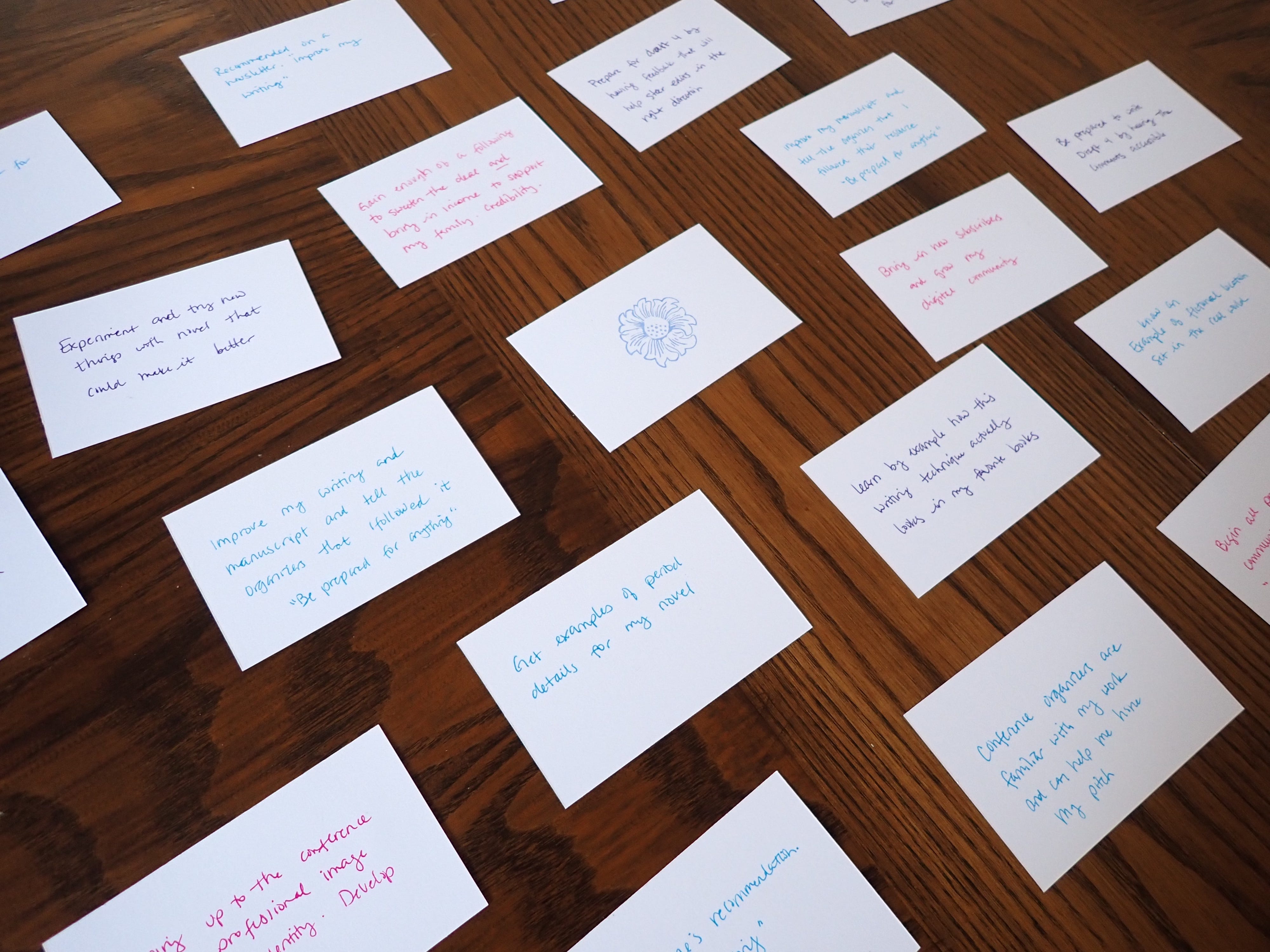
Then, I laid out all the cards and looked through my motivations. It didn’t take long to realize that some reasons were more compelling with others, so I sorted them into three piles: great reasons, medium reasons, and not compelling reasons.
One thing that helped me was the specificity of the reason – “finalize the pre-work for the conference so that I show up prepared” was much more compelling than “improve my writing.” There’s nothing wrong with wanting to improve my writing, but it was too vague, and that was a clue for me that it wasn’t as strong as the others.
The first pile became my top priorities. The last pile became my if-I-ever-have-down-time resource list. What to do with the middle? They were okay reasons, and I thought that perhaps I could achieve a similar outcome by reducing the pressure. So, I edited them down so that I could achieve the same thing with less effort – instead of reviewing the opening pages for three different books, I could do just one.
Key Thought: I’m the one steering this ship, and I get to decide where to go.
Why This Activity Worked for Me
Writing down each action helped me get it out of my brain
Putting the actions on notecards let me play around with them
Focusing on the motivations took me out of the “should” mindset into the “what-are-my-real-motivations” mindset
Sorting the notecards into different piles gave me back my sense of agency
Instead of aimlessly following every crumb of advice that I came across, I asked myself – what do I actually want? I tuned into my own voice that tells me what’s important at this moment.
And I’m not done yet – the attic is still cluttered. But this exercise helped me remember that I’m in charge and mine is a voice that I can trust.
For more from The Desk of Emily:



Thanks for sharing this. The important word here is "sharing". Why? Because there's virtually thousands of people out there giving "advice". Even large attics clutter in no time with all this "advice". Everyone's different, but me, there's only so much advice I can take. So, thanks for sharing you've decided to put advice aside for a while, and focus on what you really want.
Hi Emily,
I really like this idea and I will be trying it for sure. It was like you were describing me. I want so badly to make this my living and yea you took the words out of my mouth. I do similar things to help me clear my brain but the writing of the motivation behind it, I've never thought of that and I think it'll really help to clear the clutter and remove some of the 'should' guilt.